OPEN LETTER TO PRESIDENT OF THE UNITE NATIONS GENERAL ASSEMBLY
Afghanistan, 26 February 2026
Your Excellency Ms. Annalena Baerbock,
We write to you at a time when Afghanistan has entered one of the most profound human rights crises of
our era. This crisis is neither accidental, nor temporary, nor an unintended consequence of political
developments. Rather, it is the direct and deliberate result of the policies, decrees, and systematic
practices of the Taliban. Through the imposition of a comprehensive system of gender apartheid, this
group has consciously and progressively driven women of Afghanistan toward complete and structural
exclusion from society. This process constitutes not only a widespread and ongoing violation of
fundamental human rights, but also a systematic denial of the humanity, inherent dignity, and legal
personhood of half of the population of Afghanistan, amounting to a grave international crime.
However, the violations committed by the Taliban are not limited to gender-based oppression. The group
has simultaneously perpetrated another form of crime against humanity that, due to political
considerations and selective approaches, has received insufficient attention from the international
community. Through the deliberate weakening and systematic erasure of the Persian language, as well as
the repression, persecution, forced displacement, and marginalization of its speakers from political
participation and decision-making processes, the Taliban have established an unlawful, mono-gender,
mono-ethnic, and mono-lingual system of governance. In doing so, they have engaged in what can be
defined as “linguistic apartheid” against the Persian language. This pattern not only undermines justice
and peaceful coexistence in the society of Afghanistan, but also deepens ethnic and linguistic divisions,
exacerbates the human rights crisis, and significantly increases the risk of widespread violence, internal
conflict, and long-term instability.
Within the normative framework of human rights, no form of injustice or systematic violation can be
justified by the neglect of another. Any attempt to establish a hierarchy among fundamental rights
violations is not only ethically indefensible, but also incompatible with the universal and indivisible nature
of human rights. The existence of one form of injustice can never serve as justification for the denial,
minimization, or delay in addressing another. Contemporary human rights theory makes clear that
selective prioritization of certain violations over others does not resolve injustice. Rather, it perpetuates
complex cycles of repression, exclusion, and harm, often producing layered forms of discrimination that
disproportionately affect women.
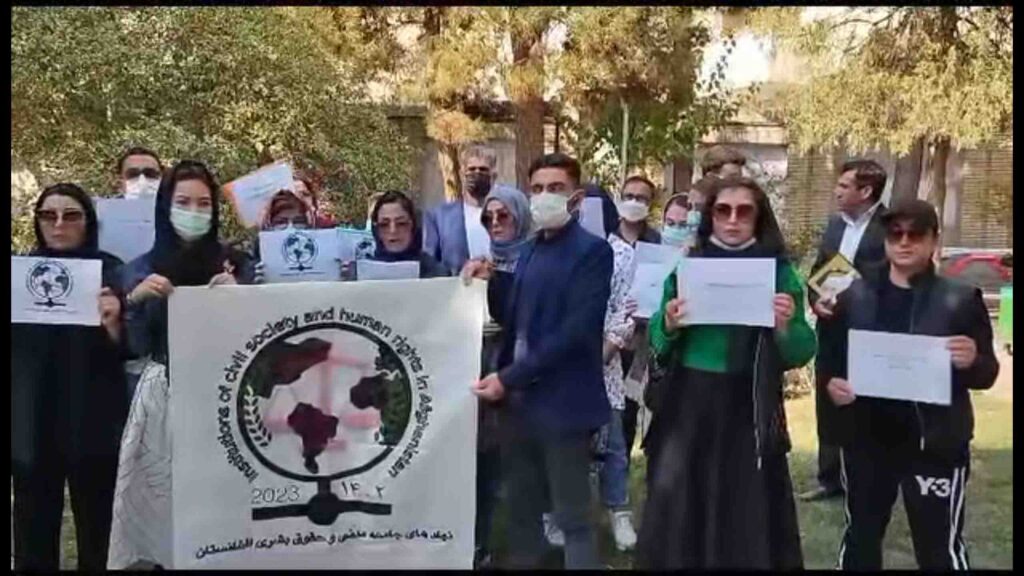
In this context, we, a coalition of human rights organizations of Afghanistan, women’s protest movements,
and democratic forces, express our deep appreciation for your commitment and leadership in upholding
universal human rights principles, particularly the fundamental rights of women. We welcome and support
your principled statements at the sixty-first session of the United Nations Human Rights Council regarding
the situation of women in Afghanistan and the recognition of gender apartheid. In light of your influential
role and responsibilities within the international system, we respectfully call upon you to exercise decisive
leadership, utilizing all available legal, diplomatic, and institutional mechanisms, in pursuit of the
following:
1• To ensure the recognition, criminalization, and cessation of gender apartheid against women of
Afghanistan, and to facilitate the prosecution of Taliban leaders as principal perpetrators of crimes
against humanity.
- To end policies of engagement, normalization, and legitimization of the self-declared Taliban
authorities, including the suspension of all processes that contribute to their international
recognition, in particular the Doha process.
We underscore that human dignity and fundamental human rights are neither suspendable nor
negotiable. Impunity enables the continuation of atrocity crimes. Continued silence or minimal responses
to the scale of systematic violations committed by the Taliban not only undermine the credibility of
institutions entrusted with the protection of human rights, but also weaken the integrity of the
international legal order and embolden patterns of repression and injustice globally.
Respectfully submitted,
A coalition of women’s protest movements and human rights organizations of Afghanistan